
IEP-MOD / CONFIGURATION INQUIRY
High-Sensitivity Modal & Seismic IEPE Sensors
Resolve small motion without losing headroom.
Low-level vibration calls for a noise specification tied to a frequency band. A high mV/g rating can improve voltage output while reducing acceleration headroom. IEPE is AC coupled and cannot measure static acceleration or DC tilt.
Request quote & calibration scope →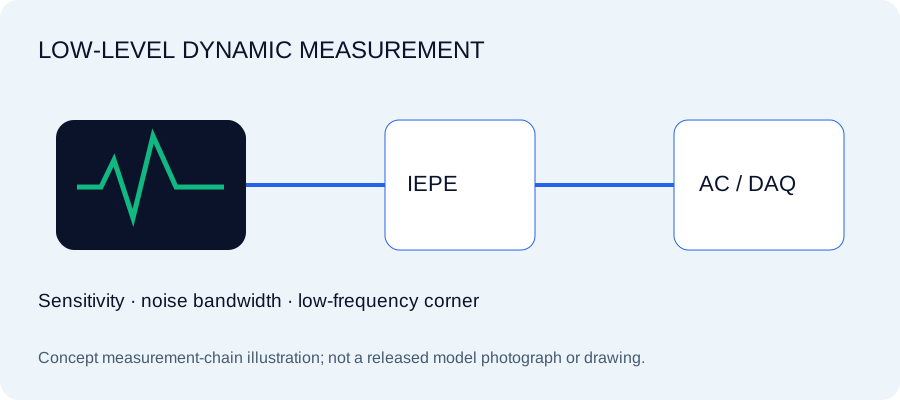
FIRST, DEFINE THE OPERATING WINDOW
Sensitivity, interface and acquisition requirements
These are request profiles. Confirm the selected model’s datasheet before ordering; the listed targets do not describe one universal configuration.
| Sensitivity targets | 500–10,000 mV/g |
|---|---|
| Frequency target | 0.05 Hz–2 kHz; selected-model confirmation required |
| Noise target | 1 µg resolution only with defined bandwidth and method |
| Mounting review | Mass loading, base strain and thermal transients |
| Channel setup | Bias settling, coupling corner and overload recovery |
Match the measurement to the test structure
Bridge and building modes: define the lowest frequency and acquisition duration. Wind-turbine blades: consider environmental protection and cable motion. Microvibration: state the velocity criterion, analysis bandwidth and noise budget.
Review an existing sensor model →Documents to review before release
Request noise spectral density and integrated noise, low-frequency response, settling time, usable range and calibration conditions. Do not assume one profile meets every target simultaneously.
Ask for available calibration method, traceability, frequency points and uncertainty. TEDS memory does not replace a current calibration record.
Cable, mounting and excitation belong in the same RFQ
Specify cable connector and pinout before selecting a cable. Magnetic mounts can reduce usable high-frequency response; holding force depends on surface and pull direction. Verify stud thread, seating surface, insulation and mounting torque. For a triaxial sensor, reserve three inputs.
Can I reuse an existing ICP® acquisition system?
Often, after checking current, compliance voltage, bias, signal headroom, coupling, connector and TEDS support. A matching sensitivity or connector is only part of the review.
Are price, stock and calibration included?
Request a configuration-specific quotation. Price, shipping date, accessory fit and calibration scope are confirmed in that quotation.
SPECIFICATION → CONFIGURATION REVIEW
Build your IEPE inquiry
Include the sensor, cable and acquisition input as one measurement chain. Request model-specific specifications and calibration scope with your quotation.
Selected family: IEP-MOD
[email protected]