
IEP-UNI / CONFIGURATION INQUIRY
Uniaxial IEPE / ICP® Compatible Accelerometers
One measurement axis. A complete signal chain.
For shaker control, bearing diagnostics and modal measurements, start with peak acceleration and the actual usable frequency band. Sensitivity alone does not determine suitability. A mounting resonance or a current-limited long cable can compromise a nominally suitable sensor.
Request quote & calibration scope →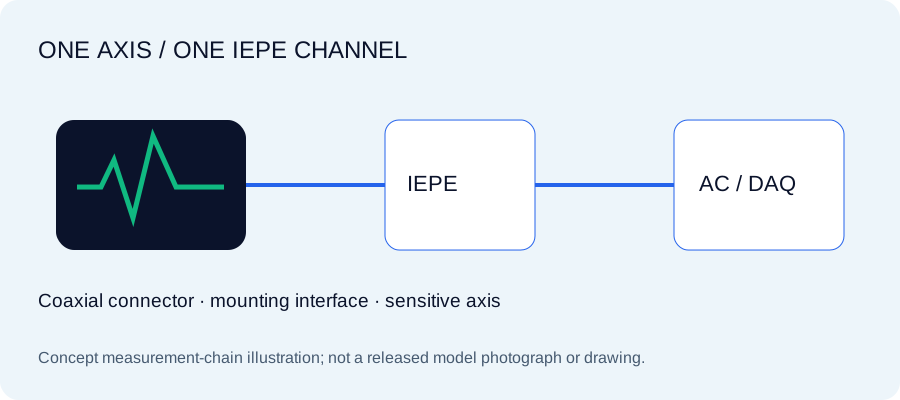
FIRST, DEFINE THE OPERATING WINDOW
Sensitivity, interface and acquisition requirements
These are request profiles. Confirm the selected model’s datasheet before ordering; the listed targets do not describe one universal configuration.
| Request sensitivity | 10 / 100 / 500 / 1000 mV/g |
|---|---|
| Illustrative ±5 V range | ±500 / ±50 / ±10 / ±5 g respectively |
| Requested band | 0.5 Hz–12 kHz; model and sensitivity dependent |
| Connector requests | 10-32 coaxial / BNC / 2-pin / M12 |
| Mount requests | 10-32 / M5 stud; adhesive or magnetic option |
Match the measurement to the test structure
Shaker-table control: verify transverse sensitivity, mounting stiffness and peak overload. Bearing diagnostics: specify the upper frequency and cable length. Modal arrays: retain channel identity and calibration sensitivity.
Review an existing sensor model →Documents to review before release
Request a frequency response curve, sensitivity tolerance, noise over a stated bandwidth, bias window, mounting torque and connector drawing for the selected model.
Ask for available calibration method, traceability, frequency points and uncertainty. TEDS memory does not replace a current calibration record.
Cable, mounting and excitation belong in the same RFQ
Specify cable connector and pinout before selecting a cable. Magnetic mounts can reduce usable high-frequency response; holding force depends on surface and pull direction. Verify stud thread, seating surface, insulation and mounting torque. For a triaxial sensor, reserve three inputs.
Can I reuse an existing ICP® acquisition system?
Often, after checking current, compliance voltage, bias, signal headroom, coupling, connector and TEDS support. A matching sensitivity or connector is only part of the review.
Are price, stock and calibration included?
Request a configuration-specific quotation. Price, shipping date, accessory fit and calibration scope are confirmed in that quotation.
SPECIFICATION → CONFIGURATION REVIEW
Build your IEPE inquiry
Include the sensor, cable and acquisition input as one measurement chain. Request model-specific specifications and calibration scope with your quotation.
Selected family: IEP-UNI
[email protected]