
IEPE PROJECT CONFIGURATION
IEPE measurement chain builder
Combine sensor, cable, conditioning and DAQ requests. Save a local draft, export your list and send one project RFQ.
UP TO 12 CONFIGURATIONS
Build a mixed IEPE project
Choose unit quantities. Add shared conditioners and DAQs as separate lines. Specifications require selected-model review.
Keep a complete copy or send by email
For long email drafts, copy the full brief or attach the text download if your email client shortens it.
Review the complete project brief
Add a valid configuration to create the project brief.
METHOD / SIGNALS ARE NOT SENSOR BODIES
Count each measured output, then review the acquisition architecture
A three-axis analog IEPE accelerometer needs one input for each axis. A force hammer needs another input; an impedance head with separate force and acceleration outputs needs two. A microphone/preamp uses an acoustic-pressure channel. A mechanical field calibrator creates a stimulus and contributes no input positions.
The builder multiplies each requested profile’s output count by its unit quantity. It sums requested DAQ input positions and conditioner channels independently. These are catalog request targets; exact hardware specifications remain subject to confirmation.
Siemens: three-channel triaxial setup ↗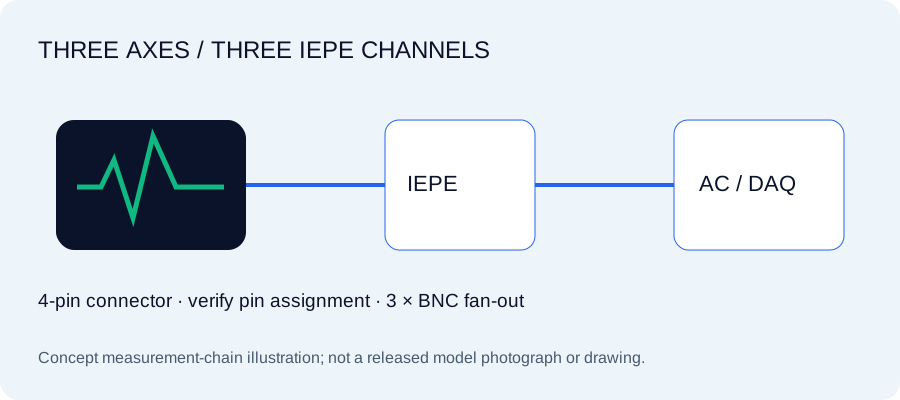
Worked modal-array example: 49 signals, not 17 channels
Planning example only: 16 triaxial sensors, one force hammer, two requested eight-input DAQs and one four-channel conditioner. It is not a validated system design or a priced bundle.
| Requested item | Units | Sensor signals | DAQ positions | Conditioner channels |
|---|---|---|---|---|
| Triaxial accelerometer | 16 | 48 | 0 | 0 |
| Force hammer | 1 | 1 | 0 | 0 |
| Eight-input DAQ request | 2 | 0 | 16 | 0 |
| Four-channel conditioner request | 1 | 0 | 0 | 4 |
| Inventory totals | 20 physical units | 49 | 16 | 4 |
The four conditioner channels do not reduce that difference. A conditioner feeds suitable acquisition inputs; it does not record four additional channels by itself. Supply your existing host inventory in the project requirements if it will cover some signals.
A common clock matters after the channel count matches
Several devices can have enough input positions in total while remaining unsuitable for a phase-sensitive FRF or NVH measurement. Request the supported shared clock/trigger, inter-channel phase, per-channel rate, anti-alias response and software arrangement. A USB connection or equal sample-rate setting does not establish synchronization.
Dewesoft: common time base and synchronization modes ↗Choose the excitation path before connecting a conditioner
A requested IEPE DAQ may already provide excitation. If an external conditioner supplies the sensor, review the receiving input’s excitation setting, bias removal, impedance and voltage range. Do not assume an external conditioner and an IEPE-enabled input can simply be cascaded.
Review IEPE current, bias and cable-drive screening →Make the exported list useful for engineering and purchasing
| In the request | Confirm before release |
|---|---|
| Exact configuration, units and accessory quantities | Approved model drawing, actual availability and final BOM |
| Original model and originating catalog page | Electrical, mechanical, phase and metrology comparison |
| Signal and input-position inventory | Routing, excitation, synchronized acquisition and software |
| Buyer-entered allowances and unpriced lines | Formal prices, calibration costs, freight, taxes and terms |
| Requested engineering documents | Genuine released files, serial/axis records and applicable lab scope |
CSV contains the line items and their original references. The complete text brief also includes the contact fields, document requests, host and project message you enter on this page. Downloaded files are request worksheets, not a formal quotation or calibration record.
Define the calibration and traceability evidence →Project draft and array-configuration questions
Does a four-pin cable turn three axes into one input?
No. The connector can carry several signals in one cable, but analog X/Y/Z outputs still require three suitable input channels. Confirm the exact pin map and fan-out.
Can I use my existing acquisition hardware?
Yes. Describe the exact host, available inputs, excitation settings and synchronization requirements in the message. Existing hardware is not included in the requested-DAQ count; the count-only difference is not an instruction to buy that many new channels.
Why are conditioners separate configurations?
They can serve several transducers. Keeping them as independent lines makes the requested number of instruments explicit and avoids listing the same shared instrument as an accessory for every sensor.
Will changing sensor units change accessory quantities?
Default sensor cable/mount quantities follow the sensor units until you directly edit an accessory quantity. After a direct edit, that accessory remains independent. Review every cable, mount and calibration quantity before sending.
Is my draft shared with another browser or device?
No. Valid line items are saved in this browser’s local storage. Contact identity, host, message and document choices are not autosaved. Download the CSV or complete text to keep a portable copy; neither file is automatically uploaded.
What if storage or email drafting is unavailable?
You can continue on this open page, download the line-item CSV or complete text, or select the visible brief and email inquiry@iepeaccelerometer.com. Long native email drafts may be shortened by individual email clients.
Does the budget figure include every project cost?
Only buyer allowances you enter are added. Missing amounts remain unpriced; freight, tax and other work can still be outstanding. Formal pricing and payment terms require a configuration-specific quotation.
Are TEDS, pinouts and calibration automatically approved?
No. TEDS request status, connector labels and document checkboxes describe needs. Request the selected-model pinout, actual host readback, serial/axis calibration and applicable laboratory scope.
Review the complete array before you send
Check sensor units, independent accessory quantities, shared instruments and missing document evidence together.
Review & send your project →