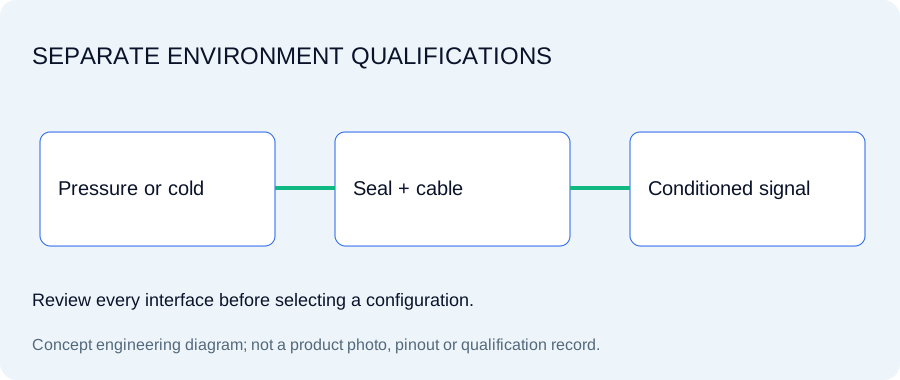
Water pressure and cryogenic temperature need different evidence.
IEP-SPEC groups two separate configuration paths: IEP-SUB for immersion and IEP-CRYO for low temperature. A water-tight housing is not automatically cryogenic, and a cold-survival limit is not the same as calibrated measurement performance at that temperature.
Original concept illustration; not a released product photo or drawing.
SPECIFY THE OPERATING WINDOW
Sensitivity, interface and environmental requirements
These values describe requested configurations. Each selected model needs its own approved specifications; the targets are not one universal performance envelope.
IEP-SPEC: parameters to confirm
Submersible request
IEP-SUB-100; specify depth, pressure, duration and fluid
Pressure target
Up to 16 bar request only; test method and assembly to confirm
Cryogenic request
IEP-CRYO-100; request down to −196°C with actual thermal cycle
Cable and seal
Integral water-blocked or cold-rated cable; connector remains part of review
Electrical review
Selected-model current, supply, bias and output range; not a blanket 18 V claim
Specify immersion pressure, dwell and the entire cable entry
For a submerged assembly, state pressure units and whether a value is gauge or absolute, depth, fluid, exposure duration, temperature and pressure cycling. The connector and cable entry must be included in the qualification. An IP designation alone does not establish a sixteen-bar continuous rating.
Separate cryogenic operation from cold survival
A low survival temperature only says the assembly may remain intact. Useful measurement requires response, bias, noise and calibration evidence at the specified cold condition, plus cooldown and warmup behavior. Ask about condensation and repeated thermal cycling.
EXACT IDENTIFIERS / ONE INQUIRY PER CONFIGURATION
Compare IEP-SPEC model requests
Select the identifier that describes your requirement, then specify accessories, documents and actual unit quantities. No identifier implies released stock or an approved cross-brand substitute.
Requested configurations · selected-model specifications and availability require confirmation
−196°C is a request target. Establish current/supply/bias, cold response, thermal cycling and cable assembly evidence before use.
Minimum-temperature request: -196°C. Released datasheet, STEP, environmental qualification and calibration availability must be confirmed for this exact configuration.
Choose a configuration, enter actual unit quantities and request the documents needed for release. Specifications, accessory fit, price and delivery are confirmed in the quotation.
Use the blank worksheet now. Request the selected configuration’s actual documents with the quote; no generic drawing or example certificate is presented as a released model record.
Offshore foundations and submerged machinery need cable-entry and pressure-cycle evidence. Cryogenic vessels and cold test structures need the sensor response through cooldown, soak and warmup, plus local cable support.
Request pressure/dwell or thermal-cycle test evidence, calibration at the relevant condition, leak/insulation results and connector/cable drawings. Keep water and cryogenic qualification records separate.
Specialized cold IEPE electronics exist, but their excitation window may differ from general laboratory sensors. The original PCB 351B41 reference specifies20–30V excitation and a3–10V bias window. Those are original-device facts; IEP-CRYO remains a request requiring its own release data.
Resolve the interfaces before final selection
Does the IEP identifier confirm an interchangeable product?
It identifies a configuration request. Exact sensitivity, frequency response, temperature, mounting, connector pin assignment, current, bias and TEDS support require selected-model confirmation. Original model names are comparison references, not approvals.
Which calibration and engineering files can I download?
The blank engineering worksheet is available without registration. Datasheet, STEP, pinout and calibration files need the actual model release. Use the document checklist in the RFQ to request availability and scope.
How do I specify the complete quantity?
Enter the number of sensors or instruments. Each accessory line has its own quantity. Triaxial sensors consume three acceleration inputs each; force and acoustic inputs are additional. Optional budget amounts are your allowances, not quoted seller prices.